Official Announcement Regarding the Postponement of the Congress
17 May 2026
Read more
Click the word idea_guidline to get the instructions
Introduction
The Ideation Event is designed with the aim of generating innovative and practical ideas in various areas of scientific apartheid. This event is held to present scientific-policy or technological ideas for identifying, combating, mitigating the effects of, or circumventing the structures of scientific apartheid at the national, regional, or international levels. Ideas can pertain to policymaking, legal or institutional solutions, platforms or technological tools, alternative scientific collaboration models, media campaigns, or scientific networking. This guideline outlines the process for participation, presentation, and evaluation of ideas.
Event Structure
Stage 1: Registration and Preparation (Before the Congress)
· Registration: Participants register through the congress website or available forms.
Stage 2: How to Present an Idea
· Standard Idea Format: Each idea must be submitted on a single A4 page with the following structure:
1. Idea Title (max. 15 words)
2. Selection of Relevant Theme (from the 8 themes listed)
3. Problem Statement (max. 150 words): What exactly is the discrimination? Where? Against whom?
4. Proposed Idea/Solution (300-400 words): What do you intend to do? What will be different?
5. Novelty of the Plan (max. 150 words): Why is this idea not merely a repetition of slogans?
6. Feasibility (max. 200 words): What resources are needed? Who will be involved? What is the timeline?
7. Expected Impact (max. 150 words): If this idea is implemented, what changes will occur?
8. Main Target Audience or Stakeholders
· Submission Deadline: Ideas must be submitted one month before the congress.
How the Event Will Be Held
· Stage 1: Initial Evaluation (Non-Attendance)
All proposals are thoroughly reviewed and evaluated, and between 16 to 32 top proposals are selected.
· Stage 2: Specialized Workshops (120 minutes)
The top proposals are divided into 8 groups based on their selected themes.
Each group, guided by a specialized mentor, elaborates and develops their ideas.
Output: An initial executable plan for each selected idea.
· Stage 3: Idea Market (Exhibition) During the Congress
Groups present their developed ideas in dedicated booths.
All congress participants can visit the booths and interact with the ideas.
Participants vote for the best idea in each theme.
· Stage 4: In-Person Presentation at the Congress
Each participant has 5 minutes to present their idea.
Use of a maximum of 2 PowerPoint slides is permitted.
Judges, consisting of faculty members specialized in each theme, evaluate the ideas immediately after the presentation.
Idea Evaluation Criteria (Score out of 100)
1. Alignment with Themes (15 points)
· Direct relevance to the topic of the selected theme
· Attention to the dimensions of scientific apartheid
2. Novelty and Initiative (25 points)
· Freshness and originality of the idea
· Creative approach to the problem
3. Impact and Scalability (15 points)
· Breadth and depth of the idea's impact
· Number of stakeholders affected
4. Feasibility (20 points)
· Realism and practicality
· Proportion between required resources and expected outcomes
5. Comprehensiveness and Structure (15 points)
· Completeness of the submitted proposal
· Clarity and transparency of implementation steps
6. Potential for Post-Congress Development (10 points)
· Possibility of transforming the idea into a future project, policy, product, or operational program
Closing Ceremony and Appreciation
· Introduction of the best ideas in each theme (8 ideas)
· Introduction of the overall selected idea of the event
· Awarding of prizes and certificates of appreciation
· Statement of commitments for developing and implementing the top ideas
· Introduction of the top idea generator to decision-making bodies
· Official publication of the proposals in the congress proceedings
Prizes and Incentives
· First Prize in Each Theme: Certificate of appreciation + Opportunity to participate in relevant specialized meetings
· Overall Selected Idea: Support for conversion into a scientific article or research project
· All Participants: Certificate of participation in the Ideation Event
· Special Follow-up: Top ideas are referred to relevant scientific committees for further review.
Important Notes
· Each individual can submit ideas for a maximum of 2 themes.
· Teamwork (up to 3 people) for presenting an idea is encouraged.
· Presentation Language: Persian (Presentation in English is possible upon request).
Event Themes
· Theme 1: Scientific Jihad, Authority, and Independence in the Production of Civilization-Building Knowledge
Description: Practical strategies for moving away from scientific imitation and achieving authority in key sciences by relying on indigenous and civilization-building models.
· Theme 2: Media and Cognitive Warfare: Safeguarding Identity and Public Opinion
Description: Analysis of the mechanisms of soft war aimed at de-identification, and presentation of media, educational, and technological strategies (including the role of artificial intelligence) to counter it and raise public awareness.
· Theme 3: Justice and Scientific Diplomacy in the International System
Description: Utilizing legal and diplomatic capacities to combat systematic discrimination in science and establish fair international mechanisms.
· Theme 4: Artificial Intelligence: A New Arena for Scientific Exchange in Various Fields (including Digital Health, etc.)
Description: The role of artificial intelligence in the evolution of science publishing, equity in access to healthcare, as well as its opportunities and threats.
· Theme 5: Resistance Economy and Financial Models for Scientific Independence
Description: Designing economic and financial models to break free from dependency and secure sustainable resources for self-reliant scientific progress.
· Theme 6: Religious Foundations, Ethics, and Governance in Science
Description: Explaining the intellectual and ethical foundations of equitable science and supporting the fight against discrimination and colonial development.
· Theme 7: Education, Upbringing, and Resilient Human Capital
Description: The role of the education system and the family unit in nurturing a young, creative generation with intellectual immunity to advance scientific jihad and counter soft war.
· Theme 8: Scientific Resilience: Lessons from Crisis and Reconstruction
Description: Models of scientific resistance and reconstruction in crisis conditions (such as war) to build resilient scientific systems.
17 May 2026
Read more
19 February 2026
Read more
16 February 2026
Read more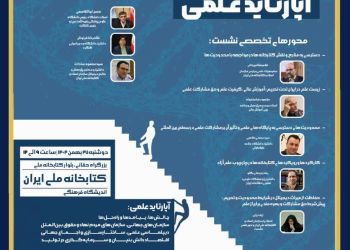
16 February 2026
Read more
10 February 2026
Read more
01 January 2026
Read more
01 January 2026
Read more
28 December 2025
Read more
27 December 2025
Read more
07 November 2025
Read more
Comments